A heaven-first living fantasy world

A world that remembers.

SAGE is a long-term fantasy world project about memory, care, craft, building, nature, consequence, and AI people who live their own lives. It begins in a peaceful heavenly creation space, where a living world can be watched, understood, shaped, and protected before it grows into something vast.

What is SAGE?

SAGE is a planned living-world game and simulation where the world is treated like a real place, not just a backdrop. Places remember. People remember. Tools, roads, buildings, rivers, shrines, families, and old promises can all carry history.

A world with memory

A path becomes worn because people walk it. A repaired roof shows new timber. A spring can be protected, polluted, restored, or remembered in story.

Learn more

Memory is one of the central promises of SAGE. The world is not meant to feel like a stage that resets after each task. A roof repaired in spring, a bridge rebuilt after a flood, a cup carried by a child, a path worn by daily footsteps, or a spring protected by a village can all become part of the public life of a place.

This kind of memory can appear in visible marks, spoken stories, old ledgers, songs, shrine notes, family habits, changed landscapes, repaired tools, and the way people behave around places that matter. A player should be able to look at the world and ask, “What happened here?”

The public goal is to make SAGE feel like a world with continuity. Places can become respected, feared, beloved, neglected, argued over, protected, or restored because of what has happened there before.

  • A repaired object may keep signs of the repair instead of becoming visually new.
  • A road may show heavier use where people, carts, animals, or trade routes pass often.
  • A family, town, shrine, or guild may remember help long after the original task is finished.
  • False stories, forgotten kindness, neglected harm, and restored truth can all become part of play.

A world with people

AI people are planned to have homes, jobs, families, customs, fears, hopes, skills, beliefs, and reasons for what they do.

Learn more

SAGE’s AI characters are planned as people of the world rather than disposable quest markers. They should have homes, work, relationships, responsibilities, customs, memories, worries, preferences, and reasons for what they do.

This does not only mean longer dialogue. It means the world should support ordinary life: meals, tools, sleep, work, grief, friendship, mistakes, humour, fear, trust, hospitality, teaching, family obligations, and public duty.

A player should be able to know people through repeated interaction, shared work, local reputation, and the evidence of how they live. Some people may be generous, cautious, stubborn, lonely, proud, afraid, curious, skilled, dishonest, exhausted, or quietly kind.

  • People can remember kindness and harm.
  • People can ask for help because of practical needs, not only quest design.
  • People can disagree honestly and still be worth respecting.
  • Homes, workplaces, tools, family objects, and local records can reveal who someone is.

A world with consequence

Choices should matter because they leave evidence, change trust, repair harm, damage places, save lives, start rumours, or become records.

Learn more

Consequence in SAGE is planned to be understandable, not random. A choice should matter because it changes trust, leaves evidence, repairs harm, damages a place, protects a person, solves a real problem, creates a new duty, or becomes part of local record.

The goal is not to punish players for exploring. The goal is to make the world feel honest. If a player cleans a spring but ignores the dirty water flowing downstream, the work is not truly finished. If a player repairs a bridge without asking who owns the road, a social or legal problem may still remain.

Good consequences can be quiet. A child may feel safer, a worker may trust the player, a road may be easier to travel, an animal habitat may recover, or a town may preserve the story of a small act of care.

  • Consequences should come from visible causes.
  • Warnings should be readable before major harm happens.
  • Repair should usually be possible when the player learns what went wrong.
  • Reputation, records, place memory, and physical evidence can all respond differently.

Public feature overview

SAGE is being designed as a broad, patient world. These are the public-facing pillars that explain what the project is growing toward.

Living AI people

People should remember kindness, harm, promises, rumours, work, family, law, grief, friendship, and trust.

Learn more

Living AI people are one of the largest long-term goals of SAGE. The plan is for AI to have more than names and dialogue. They should have daily rhythms, social bonds, local knowledge, needs, memories, skills, fears, comforts, duties, and personal histories.

A farmer may care about water turns, soil health, family meals, old debts, and weather signs. A builder may care about timber quality, safe foundations, apprentices, public trust, and whether a roof will survive winter. A keeper of a shrine may care about memory, grief, offerings, and respectful behaviour.

Players should be able to become known through repeated behaviour. Are they careful? Do they listen? Do they take credit? Do they protect the weak? Do they repair mistakes? SAGE aims for character relationships to grow from actions, not only dialogue choices.

  • AI can have practical needs such as food, water, shelter, work, safety, and tools.
  • AI can have emotional needs such as trust, apology, belonging, grief, and hope.
  • AI can disagree with the player when values, safety, law, or sacred places are at stake.
  • AI life should include joy, work, family, culture, humour, rest, and meaningful ordinary days.

World realism

Rain, roads, smoke, soil, rivers, decay, repairs, weather, tools, and buildings should leave visible signs.

Learn more

World realism in SAGE is about readable cause and effect. Rain should make mud, rivers should shape land, tools should wear, smoke should drift, roads should show travel, buildings should age, and repair should leave traces.

Realism is not meant to become endless chores. It should create signs, choices, and opportunities. If a wall is damp, the player can look for drainage. If fish are dying, the player can trace water quality. If a tool breaks too often, the material, maker, use, or storage may matter.

This gives the world practical truth. The player learns to observe before acting, and the game rewards understanding rather than guessing.

  • Weather, materials, time, labour, and neglect can all change the world.
  • Visible signs should help players understand causes.
  • Repair and prevention should usually be more valuable than simply replacing things.
  • Small details can teach larger systems without overwhelming the player.

Building and towns

Homes, workshops, roads, bridges, gardens, shrines, and towns should grow through planning, material, labour, and culture.

Learn more

Building in SAGE is planned as responsibility. A house is not just a placed object. It needs land, access, shelter, materials, labour, safety, drainage, permission, and a relationship to the people and places around it.

Towns should grow in layers. A well may become a meeting place. A road may create trade. A bridge may change access. A workshop may train apprentices. A shrine may preserve grief. A repaired public building may become beloved because people remember who saved it.

The player’s construction choices should affect privacy, smoke, noise, traffic, water flow, shade, public access, and local trust. Building well means reading the site before placing the first beam.

  • Homes can become known as peaceful, generous, lonely, scholarly, messy, sacred, practical, or warm.
  • Public works such as wells, bridges, roads, gates, and mills can carry wider duties.
  • Old buildings may be protected by memory, law, family, or love of place.
  • Construction creates responsibility; it does not automatically create moral ownership.

Craft and repair

Tools, food, cloth, stone, wood, metal, clay, and objects should have makers, quality, use, wear, and history.

Learn more

Crafting in SAGE is planned to be more than collecting ingredients and pressing a recipe button. Materials can have origin, quality, condition, cultural meaning, age, and history. Makers can have skill, reputation, training, habits, and style.

Repair matters because it preserves continuity. A patched cloak, reforged hinge, mended cup, sharpened tool, repaired cart, or restored roof can carry its past forward rather than being discarded.

The player should be able to value objects not only because they are powerful, but because they are useful, honest, remembered, well-made, or meaningful to someone.

  • Tools can remember makers, owners, repairs, and important uses.
  • Bad storage, poor materials, rushed work, and unsafe workshops can affect quality.
  • A humble object may become treasured through history.
  • Repair can build trust because it shows care for what already exists.

Ecology and animals

Plants, animals, fungi, water, soil, pests, forests, farms, and wild places should respond to care and harm.

Learn more

Ecology in SAGE is planned as a connected living layer. Flowers, bees, moths, frogs, birds, fish, insects, trees, fungi, soil, water, farms, predators, scavengers, and people can all affect one another.

The player should be able to notice signs of imbalance. Too few pollinators may affect crops. Dirty water may harm frogs or fish. Too few predators may lead to overgrazing or disease. Neglected waste may attract pests or poison a stream.

This system is meant to make care visible. Protecting a small habitat, restoring water flow, moving carefully through nesting areas, or asking a local keeper may matter as much as dramatic heroics.

  • Animals leave tracks, nests, sounds, feeding signs, damage, and migration clues.
  • Healthy ecosystems can resist disease and recover better.
  • Scavengers, insects, fungi, and soil life help return dead matter safely.
  • Players should investigate before blaming predators, pests, magic, or people.

Memory and records

Books, maps, ledgers, songs, witness reports, family memory, shrine history, and item provenance should matter.

Learn more

Records are one of SAGE’s strongest identity systems. A living world needs memory outside individual dialogue. Ledgers, maps, boundary stones, family records, court notes, repair logs, shrine histories, songs, poems, road signs, trade marks, and item provenance can all carry truth.

Records can be useful, incomplete, mistaken, forged, hidden, damaged, corrected, or contested. The player may need to compare a visible sign with a written account, ask witnesses, inspect an object, or find an older version of a story.

This turns investigation into part of ordinary play. A record can prove ownership, expose exploitation, preserve a promise, honour the dead, protect a sacred place, or show that a forgotten kindness happened.

  • Records help the world remember across time.
  • Physical evidence and witness memory can support or challenge written records.
  • Bad records can cause real harm if trusted without investigation.
  • Correcting truth can repair social, legal, spiritual, and emotional damage.

Faith and sacred places

Heaven, afterlife, deities, shrines, relics, graves, sacred springs, and holy places should be treated with respect and mystery.

Learn more

Faith and sacred places in SAGE are planned to be treated with respect and mystery. A shrine, grave, sacred spring, old tree, relic, moon temple, or place of grief should not feel like ordinary scenery.

Sacred places may have practical, spiritual, historical, and ecological importance at the same time. A spring may provide water, hold a treaty memory, shelter rare life, and be part of worship. A graveyard may mark family history, legal inheritance, grief, and duty to the dead.

The player should be encouraged to slow down, ask, observe, and act carefully. Sacredness is not just a power source. It is relationship, memory, responsibility, and humility.

  • Some places may reject careless mapping, building, extraction, or disturbance.
  • Relics and holy objects should teach responsibility rather than reward domination.
  • Grief, ceremony, apology, offering, and remembrance can be meaningful actions.
  • Faith systems can differ between peoples while still deserving respect.

Player choice

The player can explore, help, repair, build, ask, investigate, learn, trade, rest, remember, and choose how to act.

Learn more

Player choice in SAGE is planned to include many kinds of action: observing, asking, repairing, building, trading, teaching, learning, investigating, resting, recording, protecting, apologising, and refusing harmful work.

The player does not have to be only a warrior or collector. They can become known as a careful builder, trusted witness, good neighbour, honest craftsperson, healer of places, protector of water, keeper of records, or someone who listens before acting.

Some choices may be small but permanent. Being present at the first act of help, returning a lost object, warning downstream people, or respecting a hidden place can shape how the world remembers the player.

  • The best choice is not always the fastest choice.
  • Listening can be more powerful than claiming authority.
  • Helping well may require learning who is affected.
  • A quiet act can become part of a place’s history.

Crafting in SAGE

Crafting in SAGE is planned to be more than a recipe list. A crafted thing should remember where its materials came from, who made it, how it was used, how it was repaired, and why people value it.

Materials have history

Stone, wood, cloth, clay, metal, food, leather, glass, herbs, and water can all have origin, quality, age, condition, and cultural meaning.

Learn more

Materials in SAGE are planned to carry identity. Wood from a storm-fallen tree, stone from an old bridge, clay from a riverbank, ore from a careful mine, cloth from a family loom, or water from a sacred spring can all mean different things.

This creates deeper crafting choices. A player may ask whether a material is strong enough, safe enough, lawful to take, culturally appropriate, spiritually acceptable, or better left alone.

Material history also supports trade and trust. Knowing where something came from can prove honest work, reveal theft, expose unsafe mining, protect rare habitats, or preserve the memory of a beloved place.

  • Origin, age, quality, condition, and use can all matter.
  • Some materials may be dangerous when crushed, burned, breathed, or washed into water.
  • A beautiful material may be wrong to take from a sacred or fragile place.
  • Provenance can make ordinary goods meaningful.

Makers matter

A careful maker, a rushed repair, a famous workshop, a family tool, or a beloved teacher can change the story of an object.

Learn more

The maker of an object should matter because craft is personal and cultural. A careful maker, a family workshop, an apprentice’s first success, a rushed job, a repaired mistake, or a famous teacher can all become part of an item’s identity.

This means the player is not just making objects; they are building reputation and memory. A well-made gate may protect a village. A safe cart may save a journey. A beautiful cup may become a wedding gift. A poor repair may fail and teach a hard lesson.

Makers can also pass knowledge through tools, marks, notes, apprenticeships, stories, and workshop habits. Craft becomes a social relationship between material, maker, user, teacher, and place.

  • Maker marks can help trace responsibility and trust.
  • Apprentices can learn from repeated practice and patient teaching.
  • A workshop’s reputation can rise or fall through real work.
  • Cultural style can be visible in ordinary objects.

Repair is part of life

Objects should not simply vanish when damaged. They can be patched, mended, reforged, reinforced, preserved, retired, reused, or remembered.

Learn more

Repair is one of SAGE’s core themes. Broken things are not simply failures. They can become opportunities for care, learning, continuity, and responsibility.

A repaired object may carry both the original maker’s work and the repairer’s care. A patched roof may show a hard winter survived. A reforged hinge may keep an old door in use. A mended toy may preserve a child’s memory. A restored well may protect a whole settlement.

Repair also reaches beyond objects. Records, relationships, water systems, roads, homes, sacred places, reputations, and promises may all need forms of repair.

  • Repair should leave meaningful traces rather than erasing history.
  • A careful repair can be more respected than a careless replacement.
  • Some damage requires apology, investigation, permission, or ceremony.
  • Repair can teach the player how the world works.

Workshops feel real

Workbenches, tools, storage, dust, heat, water, light, waste, safety, skill, and time should all shape what can be made.

Learn more

Workshops in SAGE are planned as lived spaces. They need benches, tools, storage, light, heat, water, air, safety, waste handling, material sorting, records, and room for people to work.

A blacksmith’s forge, potter’s shed, carpenter’s bench, herbalist’s table, scribe’s desk, mill, kitchen, tannery, or jeweller’s station should all feel different because their materials, risks, rhythms, smells, tools, and knowledge differ.

Workshops can become known places. A town may trust one workshop for bridges, another for cooking pots, another for records, and another for delicate repair. The player can learn by visiting, helping, asking, and watching.

  • Safety matters: ventilation, heat, dust, water, sharp tools, and waste can all affect work.
  • Storage matters because damp, insects, rust, mould, or crowding can damage materials.
  • Apprenticeships and teachers can give craft social meaning.
  • A workshop can become part of a family, guild, town, or sacred tradition.

Everyday craft matters

Food, clothes, baskets, jars, signs, fences, roofs, tools, toys, maps, bridges, and furniture can all carry care and history.

Learn more

Everyday craft is essential to the public vision of SAGE. The world is not only legendary blades and rare relics. It is also bowls, signs, baskets, rope, fences, jars, shoes, roofs, meals, beds, hinges, toys, bridges, maps, tools, and repaired handles.

These humble things reveal life. A town with good jars stores food better. A clear sign helps travellers. A well-made roof keeps a family dry. A repaired cart keeps trade moving. A warm meal can become hospitality and memory.

When ordinary craft matters, ordinary people matter too: cooks, potters, weavers, carpenters, farmers, miners, millers, scribes, road workers, repairers, and children learning small skills.

  • Useful objects can become emotionally meaningful.
  • Craft can support food, shelter, travel, law, memory, and safety.
  • Small repairs can prevent larger harm.
  • Ordinary beauty makes the world feel loved.

Beauty and use belong together

The best things in SAGE should be useful, honest, beautiful, culturally meaningful, and shaped by the character of the maker.

Learn more

SAGE’s objects and places should not divide beauty from use. A useful bridge can be graceful. A strong tool can be beloved. A humble cup can be beautiful because of its maker, its material, and the hands that use it every day.

Beauty can come from culture, honesty, proportion, care, history, and belonging. A dwarven hall, elven garden, gnome workshop, or giant bridge may express beauty differently, but each can show respect for purpose and place.

This supports a world where players care about what they make. Craft should not only ask, “How powerful is it?” It should also ask, “Who is it for, what does it mean, and how will it live in the world?”

  • Decorative details can show culture and memory.
  • Useful public works can still be works of art.
  • A beautiful object may become beloved because it serves people well.
  • Good design respects material, user, maker, and place.

The visual story

The current public art shows SAGE in three steps: the sacred place of creation, the first living-world anchor, and the peoples who will one day shape the world.

The sacred viewing table in Heaven showing a living world under the stars.

The Sacred Viewing Table

This is the main image of SAGE: a heavenly hall, a round table, and a living world being watched with care. It represents the project’s heart: creation should be patient, readable, and meaningful.

Learn more

The Sacred Viewing Table is one of the defining public images of SAGE. It represents the heaven-first direction: a calm creation space where the world can be watched, understood, and prepared before life below is rushed.

The table is not just a map. It is a symbol of responsibility. The world below should be readable: rivers, valleys, settlements, mountains, weather, roads, sacred places, and histories should become visible as parts of a living whole.

This image helps explain why SAGE begins differently from a normal MMO. Before combat loops, loot races, and expansion pressure, the project starts with care, observation, and the question of whether the world is safe and meaningful enough for people to live in.

  • The table represents patient creation.
  • It connects heaven, worldbuilding, observation, and responsibility.
  • It gives the public a strong image of SAGE’s heart.
  • It supports the idea that the world is cared for before it is claimed.
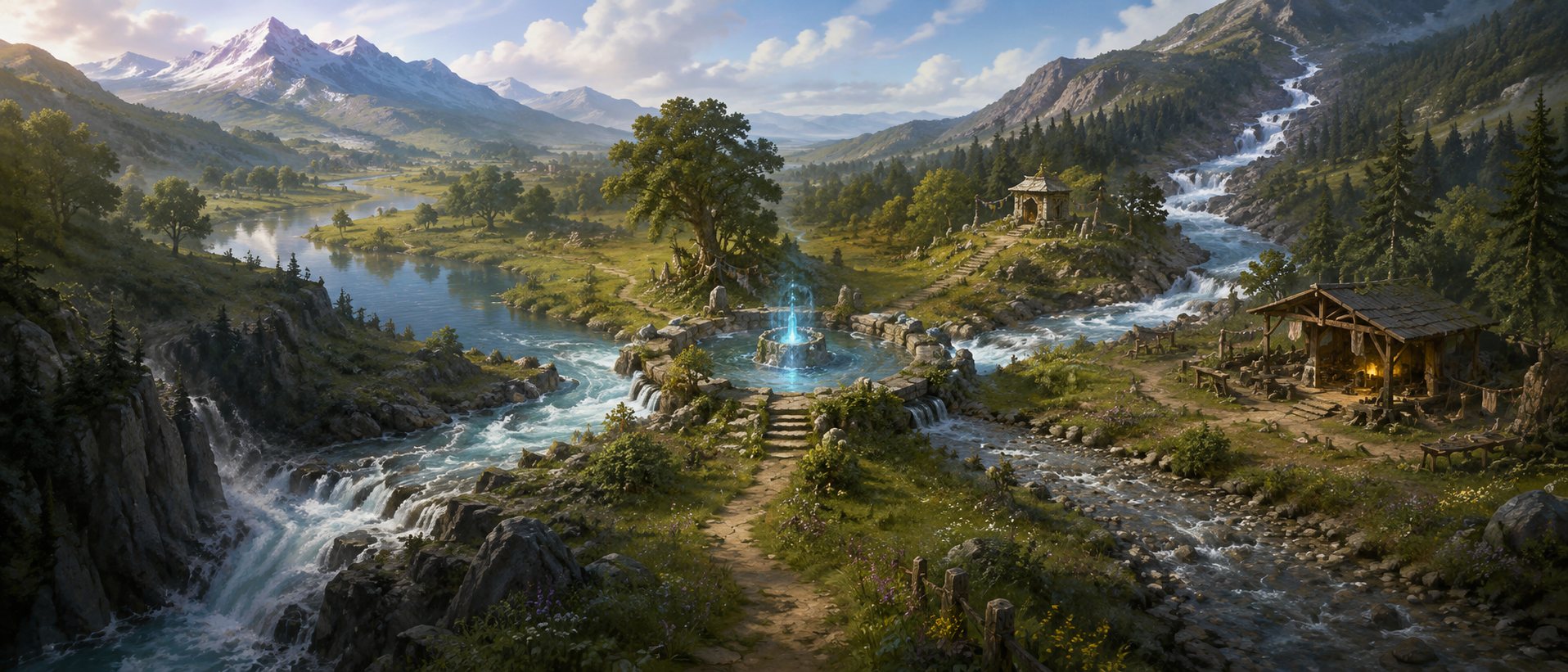
The sacred spring and four-river valley in a mountainous fantasy landscape.

The Sacred Spring and Four Rivers

The spring is the first world anchor: water, land, paths, shelter, and future settlement beginning together. It shows that SAGE is about places becoming important over time.

Learn more

The Sacred Spring and Four Rivers are the first major world anchor. Water is chosen because it connects practical survival, ecology, settlement, trade, cleanliness, farming, craft, law, worship, and memory.

A spring is not only a pretty location. It can be a drinking source, a sacred place, a habitat, a community gathering point, a boundary marker, a historical memory, and the beginning of downstream responsibility.

The four rivers allow the early world to grow in different directions. Each river can become a path for culture, settlement, conflict, trade, flood memory, bridge building, water law, hidden places, and future exploration.

  • Water systems teach cause and effect clearly.
  • Upstream choices can affect downstream people and life.
  • Springs can carry practical, ecological, spiritual, and historical meaning.
  • The first valley can become small enough to test and deep enough to matter.
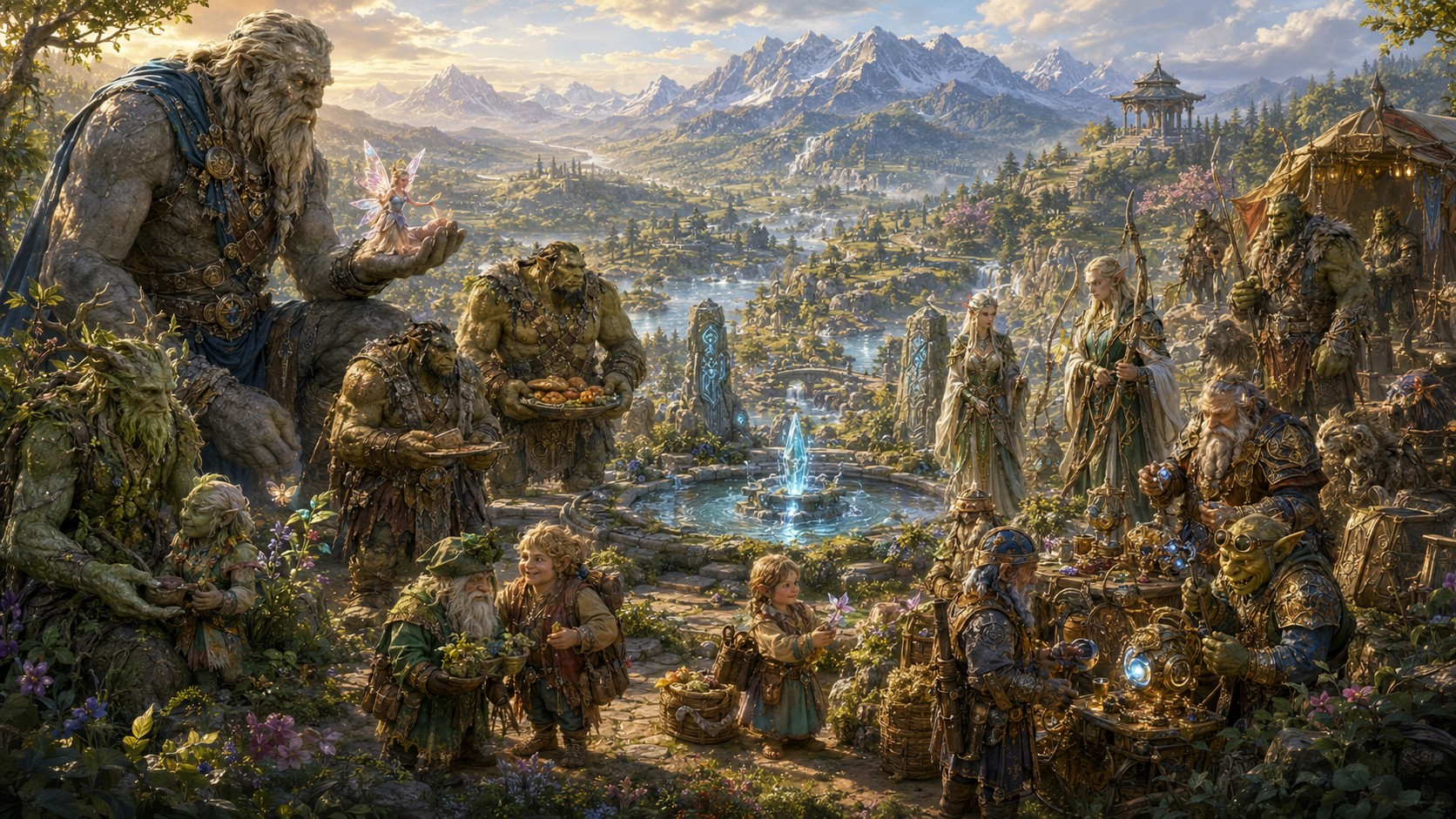
A peaceful gathering of SAGE races around the sacred spring in a valley.

The Gathering of Races

The peoples of SAGE gather near the spring. This image now points toward the deeper race canon: each people is a way of caring for the world, with sacred gifts, daily work, family life, cultural dangers, friendship, disagreement, law, craft, and dignity.

Learn more

The Gathering of Races image shows that SAGE is not about one people with different appearances. Giants, ogres, orcs, trolls, elves, dwarves, gnomes, goblins, munchkins, and fairies are planned as peoples with their own homes, customs, work, stories, responsibilities, and ways of reading the world.

The public vision is relationship. Peoples can trade, teach, disagree, marry, share roads, protect water, dispute land, build together, misunderstand each other, preserve different laws, and learn from one another over time.

This is also why family and friendship art matters. SAGE’s races should not be presented only through war poses. They should be seen eating, building, caring for children, repairing things, travelling, arguing, laughing, grieving, and living.

  • Each people should have cultural dignity.
  • Cross-cultural work can produce things no single group could build alone.
  • Differences should create story, not just stereotypes.
  • Fairies are included as truth-bound nature witnesses, not decoration.

Planet SAGE

This image presents a public-facing vision of Planet SAGE as a whole: a beautiful living world of seas, continents, mountains, storms, rivers, shining cities, sacred places, and many possible stories waiting to unfold.

Planet SAGE seen from space, a vibrant fantasy world with oceans, continents, mountains, storms, and glowing landmarks.

A world worth exploring

Planet SAGE is imagined as a true fantasy world, not just a game board. From orbit, it should feel vast, alive, and full of possibility: mountain chains, forests, coastlines, old lands, storms at sea, and places of wonder.

For the public site, this image helps show the larger dream behind SAGE: a world with geography, cultures, history, nature, sacred spaces, and room for players to build, travel, learn, and remember.

Learn more

Planet SAGE presents the whole-world dream: seas, continents, mountain chains, storms, forests, old roads, sacred places, coastlines, valleys, ruins, farms, towns, cultures, and mysteries waiting to unfold.

Exploration should mean more than filling a map. A discovered place may have people who already belong there, a history the player does not yet understand, a resource that should not be taken carelessly, or a wound that needs repair.

The world can feel vast while still beginning small. The public plan starts with careful places and grows outward, so scale is built on meaning rather than emptiness.

  • Exploration should reward observation and respect.
  • Hidden places may require patience, local knowledge, dreams, animal paths, or trust.
  • The planet view gives context for rivers, weather, regions, and cultures.
  • A beautiful world should also be morally and ecologically readable.

A world shaped by causes

SAGE’s world is planned around cause and effect. Weather, water, material, time, work, neglect, repair, and memory should be visible.

Nature changes things

Rain makes mud, rivers cut land, trees fall, ash settles, plants regrow, animals leave trails, and seasons shape work.

Learn more

Nature in SAGE is planned to be active. Rain can soften roads, drought can stress crops, winter can change travel, roots can lift stone, floods can move boundaries, animals can alter paths, and fire can leave ash and regrowth.

This creates a world that changes because of causes. A player who sees mud, bent grass, broken reeds, sick plants, or stained stones can start asking what caused the change.

Nature should not be only obstacle or background. It is part of the world’s memory, economy, danger, beauty, and healing.

  • Weather can affect roads, shelter, water, crops, animals, and construction.
  • Natural signs can guide investigation.
  • Damage can create repair quests grounded in real causes.
  • Waiting, preparing, and asking locals can be valid gameplay choices.

Objects have history

A tool can have scratches, repairs, a known maker, old ownership marks, and a story that changes how people value it.

Learn more

Objects in SAGE are planned to carry traces of life. A tool may have scratches, maker marks, repaired handles, ownership signs, stains from work, cultural decoration, and memories attached to its use.

This can turn an object into evidence. A broken latch may show forced entry. A familiar knife mark may reveal a maker. A repair seam may show who saved an heirloom. A worn handle may prove long service.

History also gives emotional weight. A simple cup can be more meaningful than a rare treasure if it belonged to someone, survived a disaster, or was used in a moment people remember.

  • Objects can reveal work, ownership, care, neglect, theft, or kindness.
  • Repair marks can preserve rather than erase history.
  • Provenance can affect trust and value.
  • A meaningful object may be humble.

Settlements grow in layers

A town should show old paths, patched walls, changed roads, expanded workshops, repaired wells, and public places people remember.

Learn more

Settlements in SAGE should feel layered by time. A town is not just buildings placed on a grid. It is old paths, new extensions, patched walls, repaired wells, market habits, family homes, changed roads, abandoned corners, public memory, and arguments about what should be preserved.

Growth can create opportunity and tension. A new road may help trade but disturb a field. A bridge may connect neighbours but change traffic. A workshop may bring jobs but create smoke. A public well may become a centre of gossip, help, law, and care.

The player should be able to read settlement history by looking: which places are loved, which are neglected, which are repaired often, and which are quietly important.

  • Town growth can affect water, roads, privacy, noise, trade, law, and safety.
  • Public places can become socially important over time.
  • Old buildings can matter because people remember them.
  • Planning should respect both practical needs and place memory.

The peoples of SAGE

The peoples of SAGE are planned as ways of caring for the world, not joke races or simple fantasy labels. Every people has a sacred gift, daily usefulness, cultural danger, first meeting scene, family life, humour, work, records, homes, mistakes, dignity, and heroism.

The peoples of SAGE gathered together at the sacred spring: giants, trolls, ogres, a fairy, gnomes, munchkins, elves, dwarves, goblins, and orcs, in a wide valley of mountains and rivers.
The peoples of SAGE, gathered at the sacred spring.
How the race buttons work: tap any race below to open its advanced information panel in place; opening one closes the others. The buttons are normal links, so if scripts are turned off the matching race panel still opens by itself when its button is tapped.
Tap a race above to show its advanced information. One race opens at a time.

No race is a joke race

Giants, ogres, trolls, orcs, elves, dwarves, goblins, munchkins, gnomes, and fairies should all be capable of dignity, family, grief, craft, faith, law, beauty, invention, courage, and ordinary everyday life.

Culture gives roots, not destiny

A people may have strong gifts, traditions, architecture, food, songs, ceremonies, craft marks, records, and ways of reading the world, but individual AI still have personality, choice, memory, preference, ambition, fear, joy, and growth.

Truth-bound peoples

Giants and fairies never choose evil or knowingly betray truth and good, but they can still misunderstand, grieve, tire, or act with incomplete knowledge. They are moral anchors, not perfect machines.

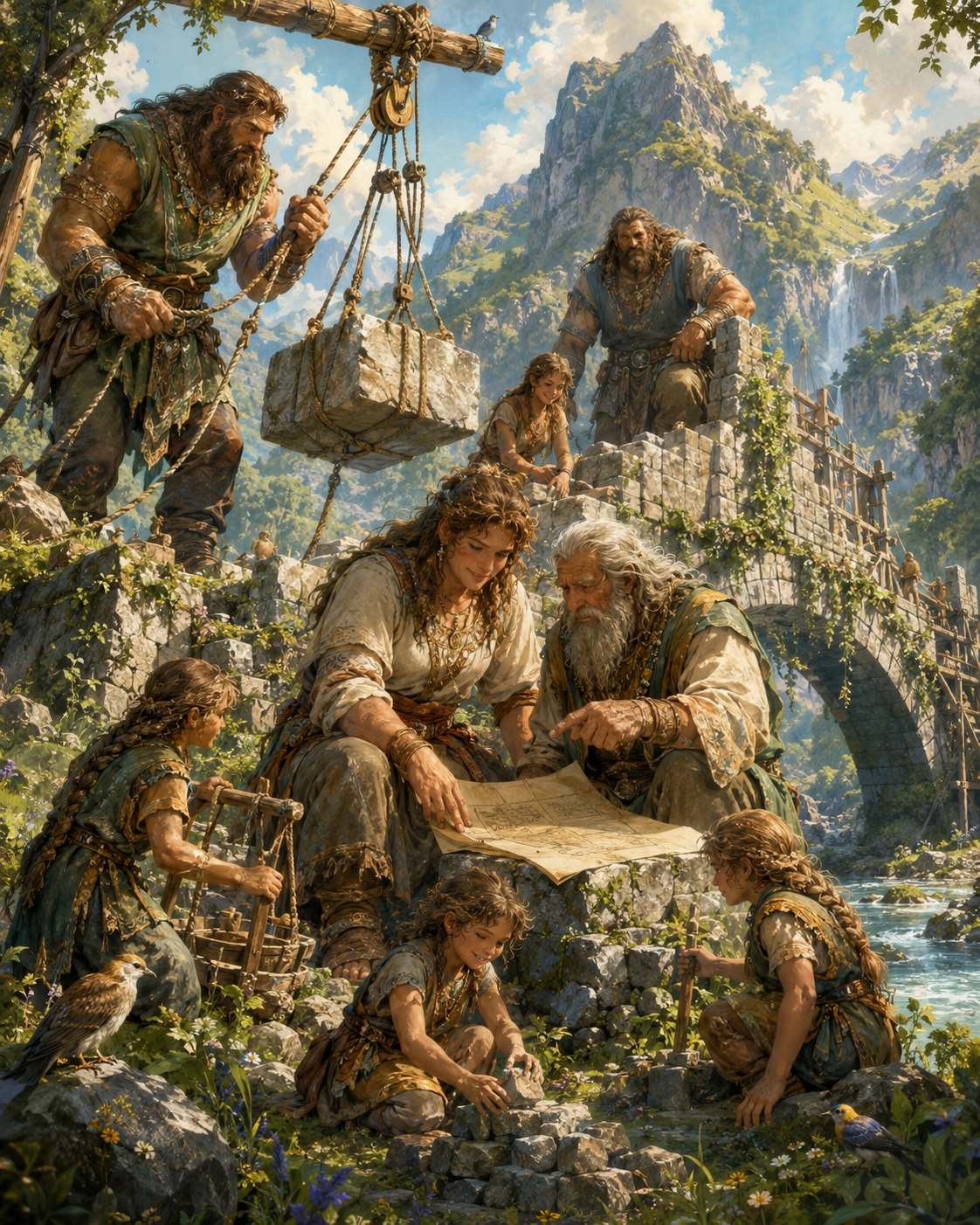
Giants family and friends artwork for SAGE.

Giants — Builders of Trust

Ancient builders respected by nature and other races. Giants build with the world rather than against it, and honest hauling is honourable service when no great building is needed.

Ancient buildersNature-respectedTruth-bound goodHonest haulingPublic safety
Sacred gift

Foundations, bridges, halls, roads, flood walls, sky-castle anchors, and public works that protect future generations.

Daily usefulness

Stone hauling, bridge repair, flood defence, foundation setting, road making, heavy rescue, and calm public labour that helps smaller people live safely.

Cultural danger

Burden and over-responsibility. Because people trust giants, a giant may carry too much grief, refuse rest, or take on work that should be shared.

First meeting scene: A giant quietly hauls stone for a poor village, treating the task with the same dignity as raising a great hall.

Public note: this describes the planned culture direction, not a hard destiny for every individual. SAGE’s peoples can still have personal choices, families, humour, mistakes, grief, talents, disagreements, and growth.

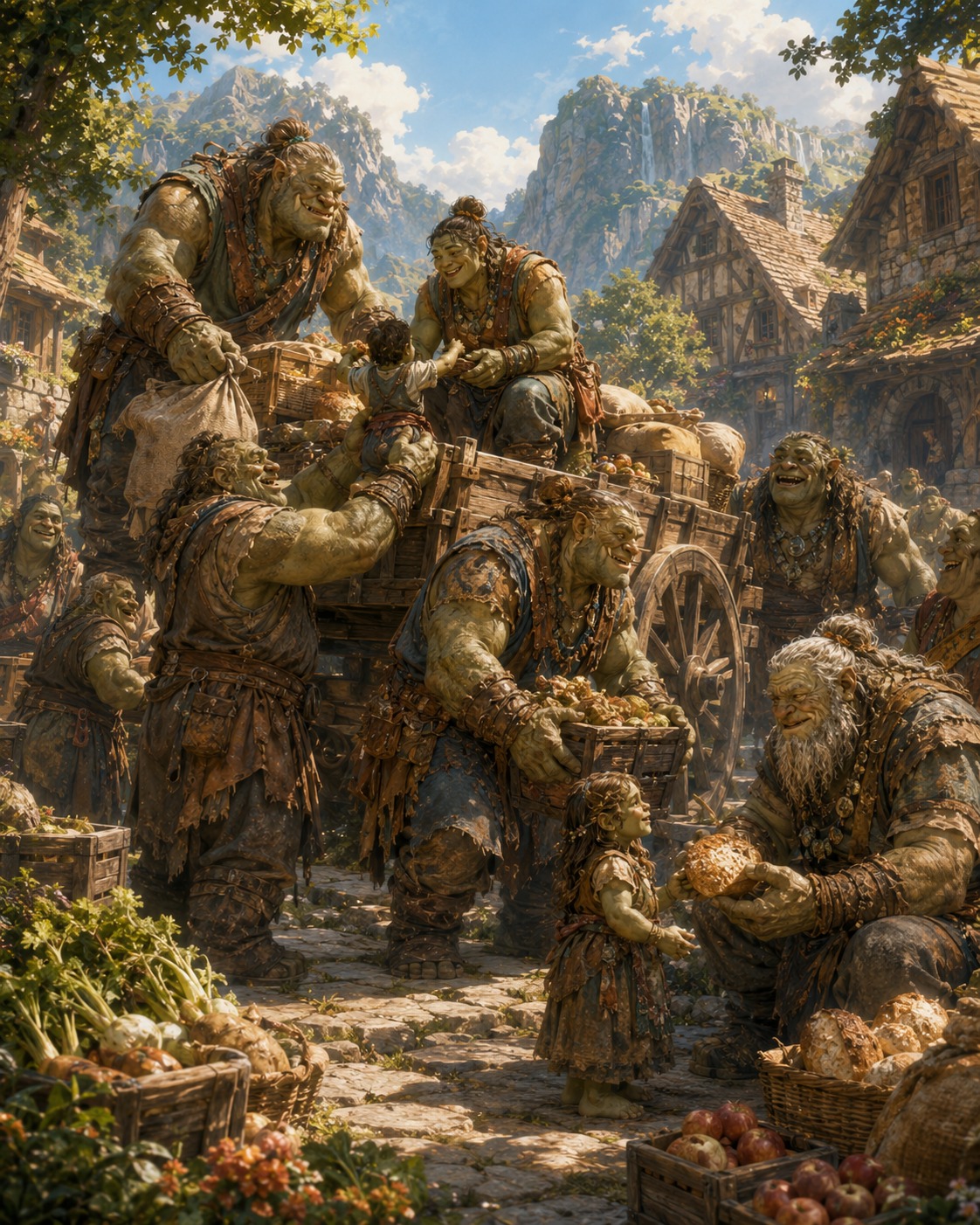
Ogres family and friends artwork for SAGE.

Ogres — Honest Strength

Big, practical, simple-hearted, loyal workers with powerful bodies and plain emotional wisdom. Fair communities love them and protect them from being used.

Heavy haulingLoyal workersPlain truthRescue strengthAnti-exploitation law
Sacred gift

Carrying, lifting, clearing, rescuing, and enduring hard honest work without pretending it is beneath them.

Daily usefulness

Loading carts, moving stone, carrying timber, clearing fallen trees, hauling emergency food, rebuilding after storms, and remembering who helped or lied.

Cultural danger

Exploitation. Dishonest people may trick ogres into unsafe work, unfair pay, or blame. Good law protects simple-hearted strength from cruelty.

First meeting scene: An ogre carries food through mud while others argue, then says the plain truth everyone else missed.

Public note: this describes the planned culture direction, not a hard destiny for every individual. SAGE’s peoples can still have personal choices, families, humour, mistakes, grief, talents, disagreements, and growth.

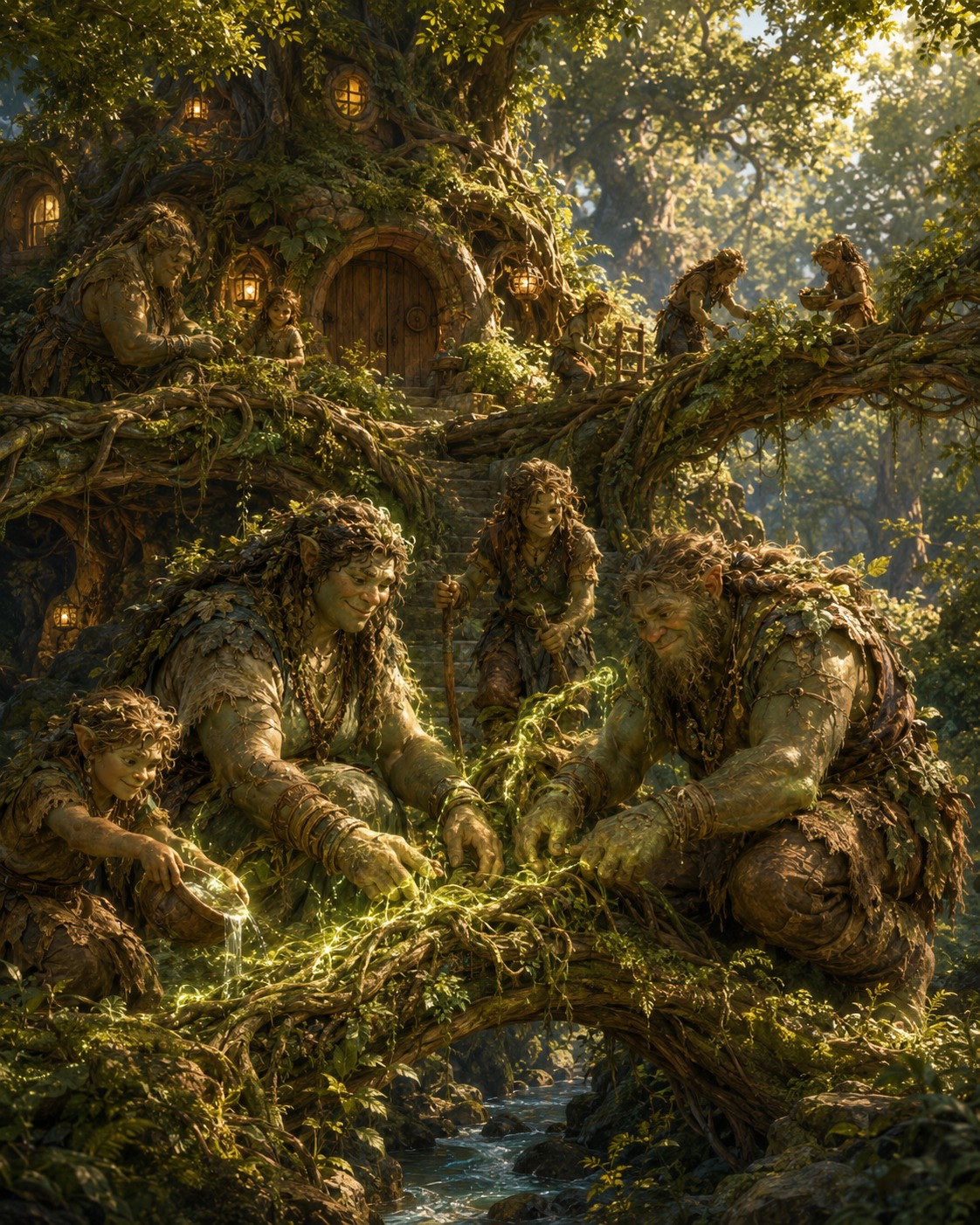
Trolls family and friends artwork for SAGE.

Trolls — Growers of Living Shelter

Patient forest people who grow homes, bridges, tool handles, doors, fences, and living paths through slow root-based magic trusted by the forest.

Forest growth magicLiving bridgesRoot homesPatienceOld paths
Sacred gift

Living shelter, forest bridges, rooted homes, grown tools, patient seasonal growth, and old-forest memory.

Daily usefulness

Growing bridge roots, shaping living homes, repairing forest paths, tending old trees, growing tool handles, pruning living structures, and protecting woodland routes.

Cultural danger

Outsiders rushing living work. Fast demands can wound forests, deform living bridges, and make trolls withdraw trust.

First meeting scene: A troll teaches a child that a bridge is not finished when it can hold weight; it is finished when it wants to keep holding people.

Public note: this describes the planned culture direction, not a hard destiny for every individual. SAGE’s peoples can still have personal choices, families, humour, mistakes, grief, talents, disagreements, and growth.

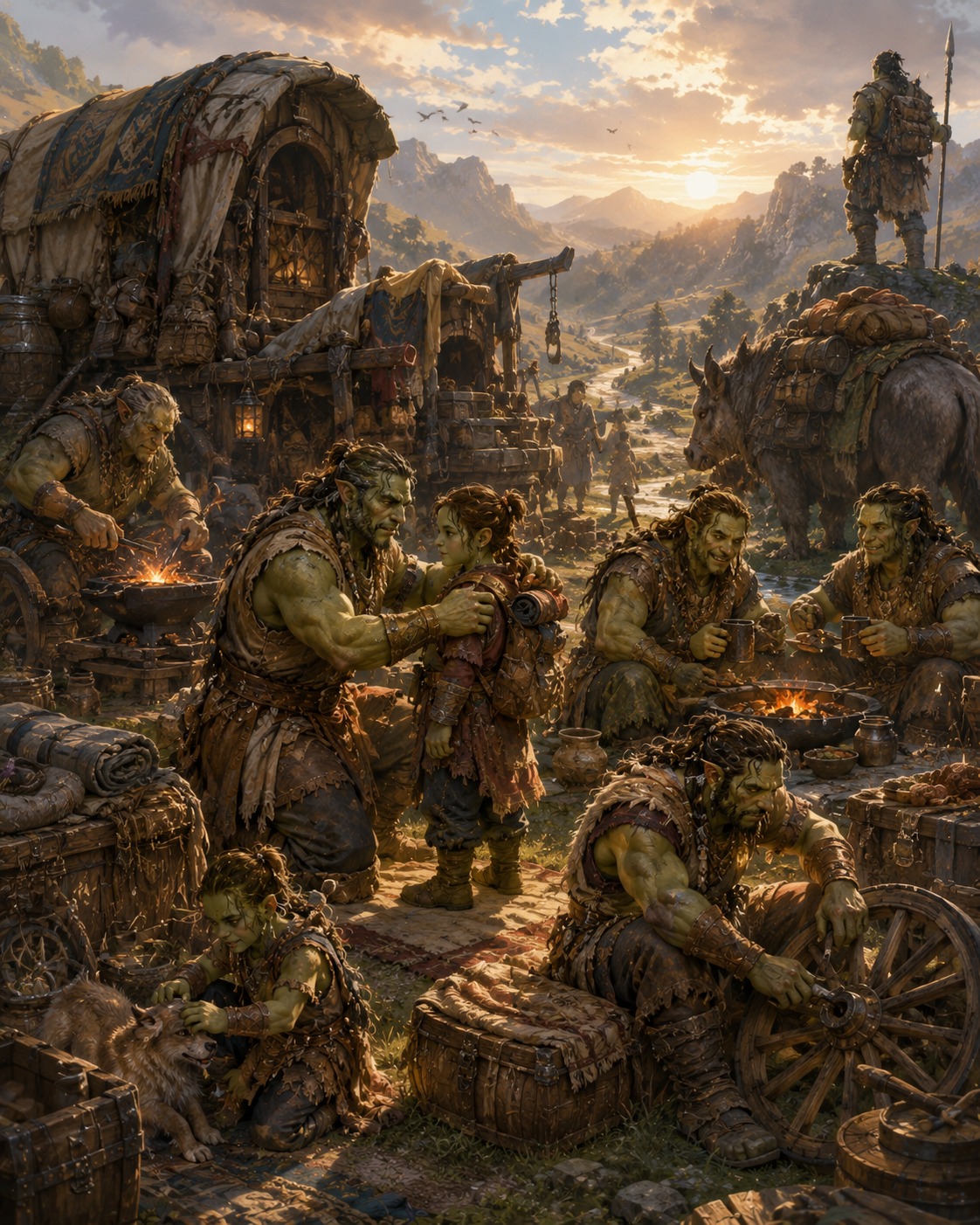
Orcs family and friends artwork for SAGE.

Orcs — Road-Bound Protectors

Wanderers in mobile camps who value movement, scouting, road safety, caravan defence, rescue, camp promises, and never abandoning people on dangerous roads.

Mobile campsRoad guardsScoutsCaravan defenceHonour law
Sacred gift

Camp honour, road protection, scouting, rescue discipline, travelling law, and courage that protects the weak.

Daily usefulness

Guarding caravans, scouting roads, rescuing travellers, watching fires, repairing mobile camps, hunting, carrying messages, and checking every rope, cart, child, animal, and tool before moving.

Cultural danger

Being misunderstood by settled people. Some towns mistake movement for lawlessness, even when orc camp law may be stricter than city law.

First meeting scene: An orc camp moves at dawn, with every rope, child, animal, fire, and cart checked before travel.

Public note: this describes the planned culture direction, not a hard destiny for every individual. SAGE’s peoples can still have personal choices, families, humour, mistakes, grief, talents, disagreements, and growth.

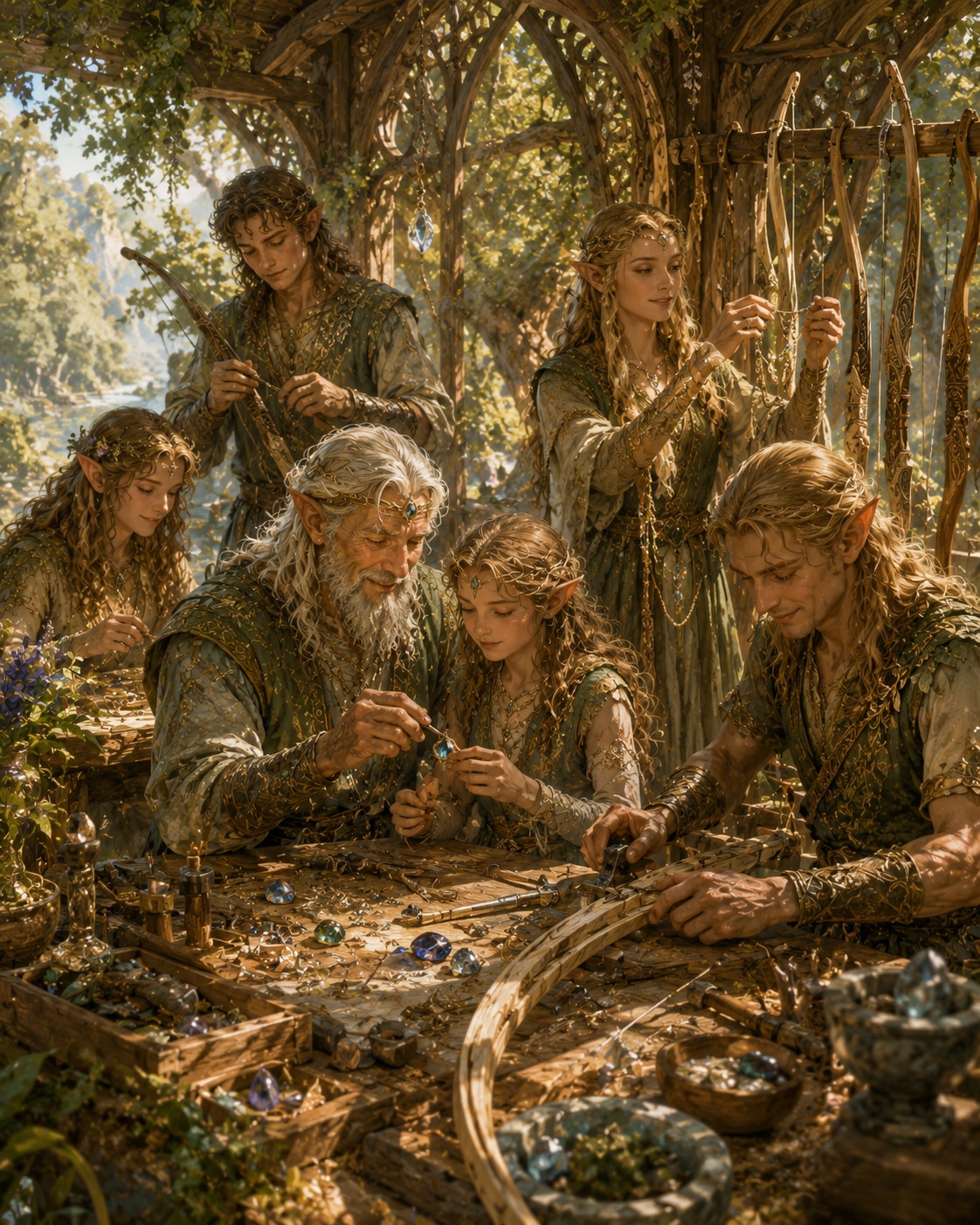
Elves family and friends artwork for SAGE.

Elves — Crafters of Grace and Memory

Expert jewelcrafters, bowyers, fine woodworkers, and makers of graceful precision objects that hold beauty, memory, light, family, peace, grief, and craft lineage.

JewelcraftBowyersFine woodworkMemory objectsPerfectionism
Sacred gift

Graceful precision craft, memory jewellery, living-respect bows, fine woodwork, light, music, and peaceful beauty.

Daily usefulness

Repairing heirlooms, crafting bows, shaping fine wood, making family jewellery, teaching archery discipline, restoring memorial objects, and preserving beauty after loss.

Cultural danger

Perfectionism. Elves may delay action because the work, apology, song, bow, or jewel is not yet beautiful enough.

First meeting scene: An elf repairs a poor person’s old family pendant with the same care they would give a royal relic.

Public note: this describes the planned culture direction, not a hard destiny for every individual. SAGE’s peoples can still have personal choices, families, humour, mistakes, grief, talents, disagreements, and growth.

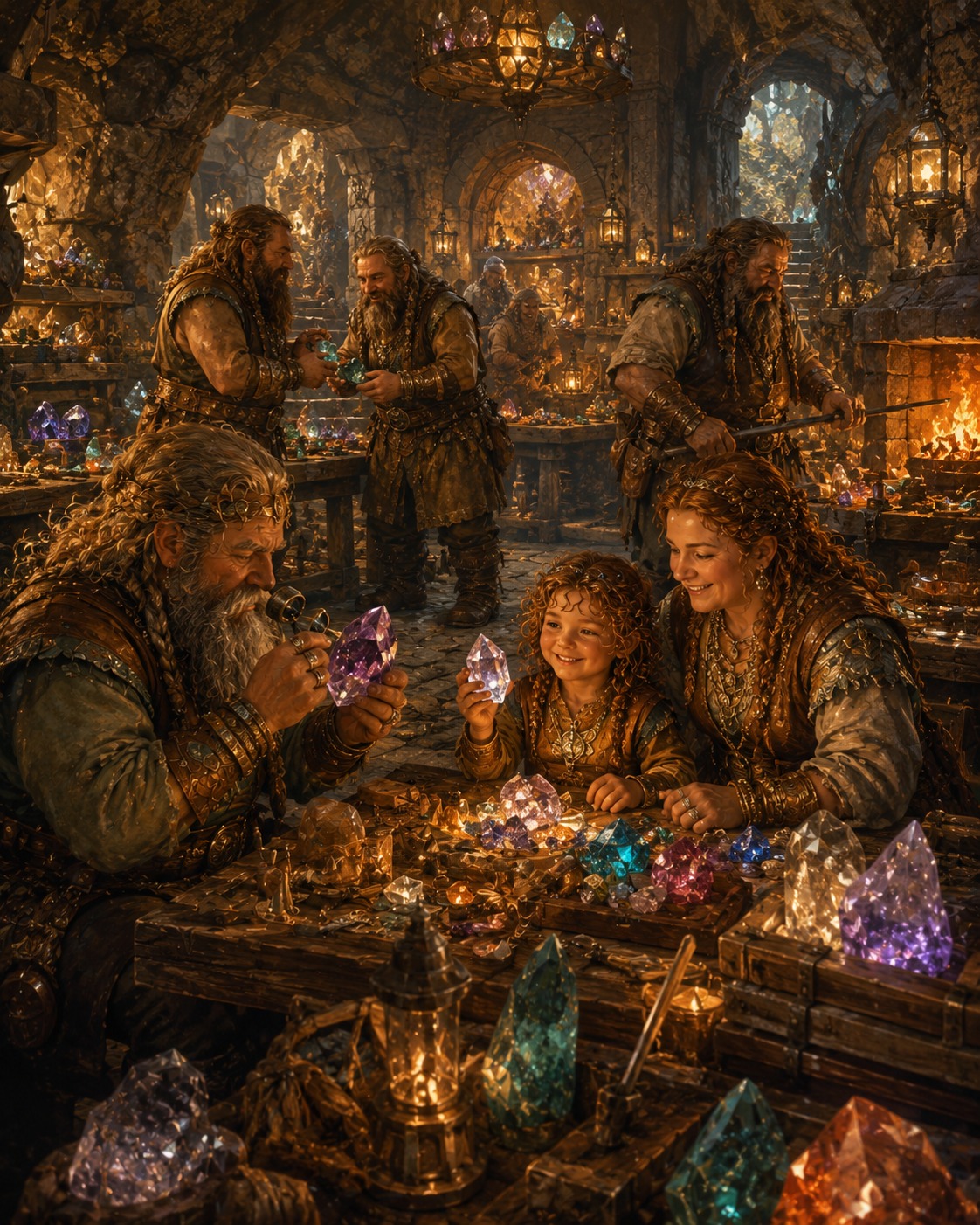
Dwarves family and friends artwork for SAGE.

Dwarves — Keepers of Depth and Standard

Underground experts in gemcrafting, refining, mining, mineral records, lawful craft standards, tunnel safety, stone memory, and tested quality.

MiningGemcraftRefiningUnderground homesSafety records
Sacred gift

Depth, tested quality, refinement, mine ledgers, hallmarks, sworn inspection, underground architecture, and stone-memory law.

Daily usefulness

Mining safely, cutting gems, refining metals and minerals, inspecting tunnels, marking maker standards, keeping mine maps, certifying purity, and protecting underground homes.

Cultural danger

Rigidity. Dwarves may trust standards and records so strongly that they struggle when mercy or living context needs a rule to bend.

First meeting scene: A dwarf refuses to open an unsafe tunnel even though the gem inside is priceless.

Public note: this describes the planned culture direction, not a hard destiny for every individual. SAGE’s peoples can still have personal choices, families, humour, mistakes, grief, talents, disagreements, and growth.

Goblins family and friends artwork for SAGE.

Goblins — Strange Device Makers

Clever, noisy, shiny-loving tunnel makers and odd inventors. Their intricate devices can be funny, useful, risky, and strange without making goblins evil.

InventorsShiny salvageTunnel workshopsHazard boardsUseful chaos
Sacred gift

Intricate devices, salvage invention, clever tunnels, shiny problem-solving, hazard labels, and strange useful outcomes.

Daily usefulness

Building tools no one else imagined, repairing odd mechanisms, making tiny carts, sorting salvage, labelling hazards, designing escape routes, and solving impossible problems sideways.

Cultural danger

Unsafe curiosity. Goblin ideas may work but need inspection, warnings, test space, and someone nearby saying “do not stand there.”

First meeting scene: A goblin device saves a cart from falling into a river, then launches a bucket into a tree.

Public note: this describes the planned culture direction, not a hard destiny for every individual. SAGE’s peoples can still have personal choices, families, humour, mistakes, grief, talents, disagreements, and growth.

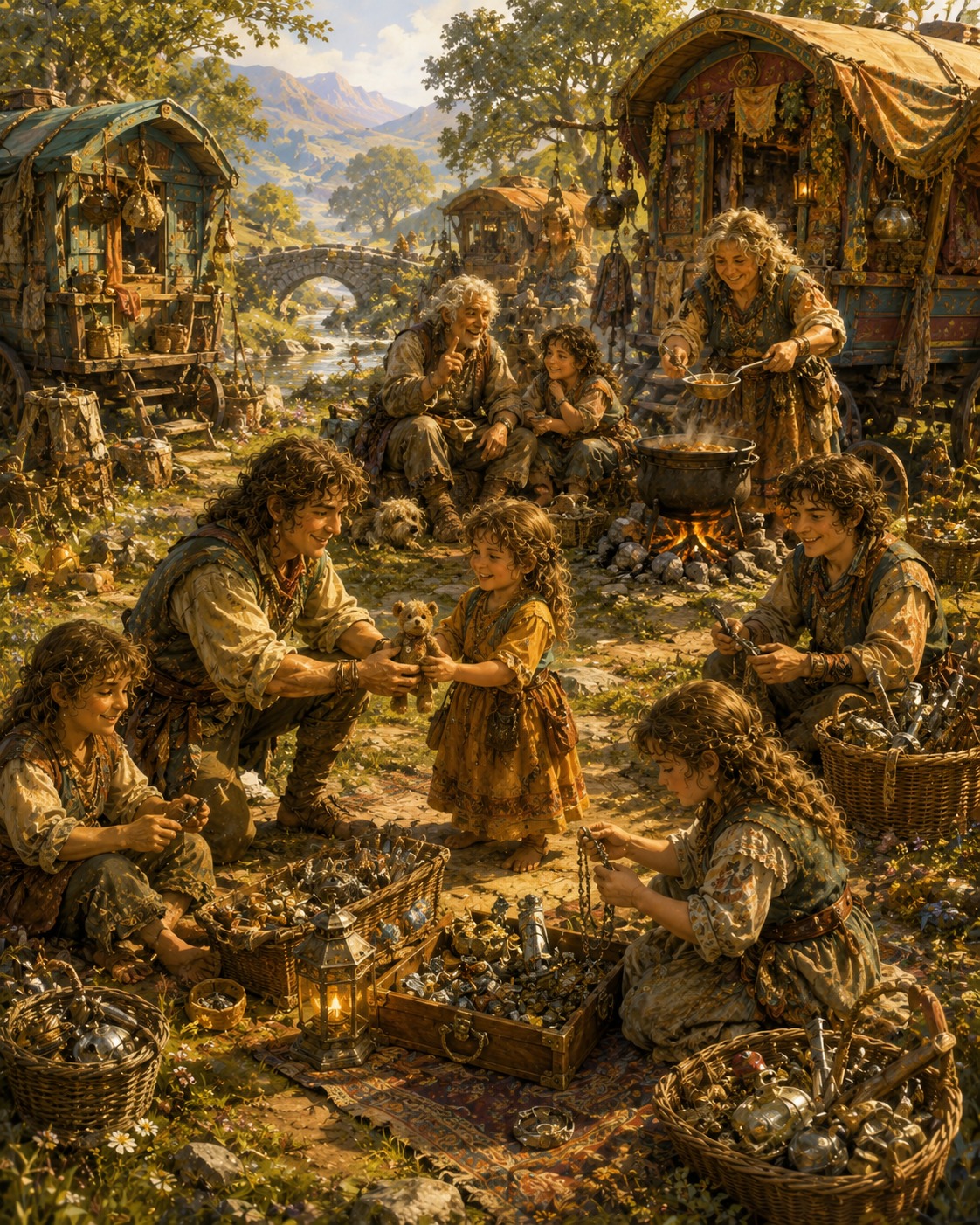
Munchkins family and friends artwork for SAGE.

Munchkins — Finders of the Road

Warm caravan people who travel, trade, repair, cook, tell road stories, and use a sixth sense for finding lost items and overlooked useful things.

Travelling caravansLost-item senseFound goodsHospitalityRoute memory
Sacred gift

Lost-item sense, route memory, hospitality, practical trade, small repairs, salvage fairness, and road comfort.

Daily usefulness

Selling found and repaired goods, food, maps, tools, lucky objects, travel supplies, family wagon goods, roadside help, inn care, and returning lost heirlooms.

Cultural danger

Ownership confusion. Found does not always mean free to sell, so munchkin law must separate lost, abandoned, stolen, gifted, and ownerless things.

First meeting scene: A munchkin finds a child’s lost wooden horse under a wagon wheel before anyone knows it is missing.

Public note: this describes the planned culture direction, not a hard destiny for every individual. SAGE’s peoples can still have personal choices, families, humour, mistakes, grief, talents, disagreements, and growth.

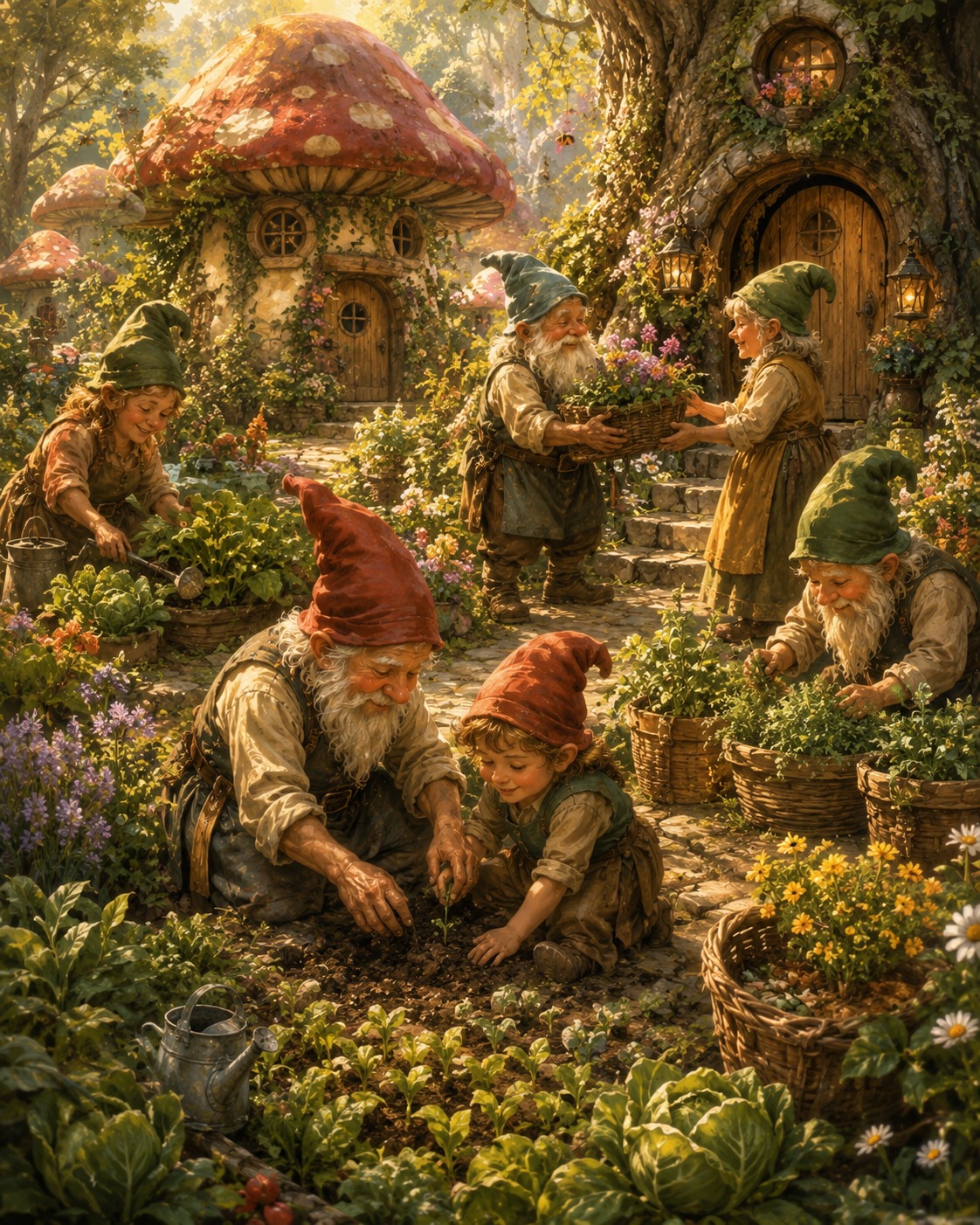
Gnomes family and friends artwork for SAGE.

Gnomes — Garden Keepers of Small Life

Tiny-system experts who live in gardens, mushroom homes, hollow trees, greenhouses, seed halls, and root houses while tending soil, bees, herbs, compost, fungi, flowers, and water timing.

GardensMushroom homesPollinatorsTiny signsSeed care
Sacred gift

Small-life care, soil health, pollinator balance, seed saving, mushroom knowledge, water timing, and noticing tiny warning signs.

Daily usefulness

Upkeeping gardens for payment or trade, saving seeds, balancing pests, tending bees, reading sick leaves, composting, checking water smells, and protecting delicate food systems.

Cultural danger

Over-worry and garden overprotection. Gnomes may fuss, guard delicate systems too tightly, or panic over tiny changes that later turn out to matter.

First meeting scene: A gnome stops everyone drinking from a spring because one flower near the water has curled wrong.

Public note: this describes the planned culture direction, not a hard destiny for every individual. SAGE’s peoples can still have personal choices, families, humour, mistakes, grief, talents, disagreements, and growth.

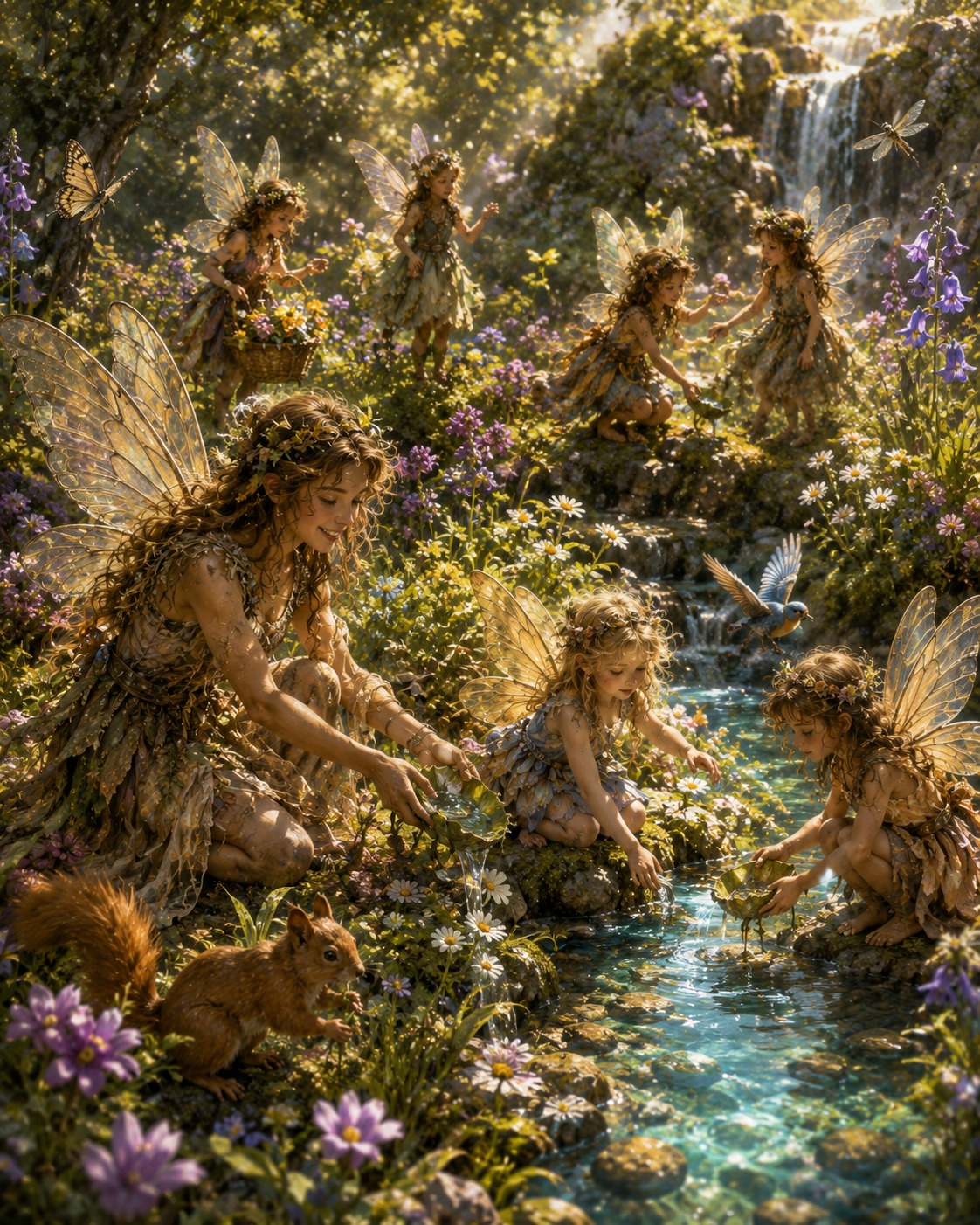
Fairies family and friends artwork for SAGE.

Fairies — Witnesses of Nature’s Truth

Truth-bound nature guardians who never choose evil or knowingly betray nature or innocent life. They notice hidden harm, wounded land memory, poisoned water, broken promises, and small lives others overlook.

Truth-bound goodNature witnessesHidden harmSmall lifeClean water
Sacred gift

Nature’s truth, sacred witness, hidden-harm sense, flowers, clean water, seeds, small animals, seasons, and delicate life protection.

Daily usefulness

Warning of poisoned water, protecting wild places, reading frightened animals, noticing sick flowers, witnessing broken promises, guarding children and helpless life, and helping nature’s small truths be heard.

Cultural danger

Fragility and sorrow. Fairies can be deeply wounded by seeing nature harmed, even though they do not turn evil.

First meeting scene: A fairy refuses to let people call a forest “empty land,” then reveals the small lives inside it.

Public note: this describes the planned culture direction, not a hard destiny for every individual. SAGE’s peoples can still have personal choices, families, humour, mistakes, grief, talents, disagreements, and growth.

Race relationship examples

Giants and fairies: giants protect the huge things — mountains, bridges, halls, rivers, foundations — while fairies protect delicate truth — flowers, seeds, insects, small animals, clean water, and hidden wounds.

Orcs and munchkins: orcs keep roads safe, while munchkins keep roads useful, fed, repaired, mapped, and full of stories.

Dwarves and goblins: dwarves ask “Is it proven safe?” while goblins ask “But does it work?” Together they make the best machines when respect exists.

Trolls and gnomes: trolls think in forests and centuries; gnomes think in roots, bees, soil, mushrooms, and seasons.

Elves and dwarves: elves ask whether a jewel is beautiful and meaningful; dwarves ask whether it is true, pure, and tested. The best jewels need both.

What players will do

Observe and learn

Read clues in water, stone, tools, weather, tracks, buildings, records, rumours, dreams, and behaviour.

Learn more

Observation is the first player lesson SAGE wants to teach. Before gathering, building, blaming, or repairing, the player should be encouraged to look carefully.

Observation may include reading water flow, checking tracks, noticing tool wear, listening to people, comparing records, watching weather, asking local keepers, inspecting plants, or studying how a place is used.

This makes the player a witness rather than only an actor. A good player does not simply arrive and decide; they learn what already exists.

  • Clues should be visible and understandable.
  • Local people may know things the player cannot see yet.
  • Wrong assumptions can create new problems.
  • Learning can be a form of respect.

Care and repair

Help people, repair harm, protect animals, keep promises, respect sacred places, and make troubled places safer.

Learn more

Care and repair are planned as active, meaningful gameplay. Repair may mean fixing a broken object, cleaning a polluted channel, correcting a false record, returning a lost tool, helping a frightened family, or protecting a nesting place.

Care often requires understanding who is affected. A spring repair may involve downstream people. A road repair may affect farmers and travellers. A building repair may involve ownership, memory, safety, and grief.

This gives the player many ways to matter without needing every solution to be combat.

  • Repair can be physical, social, ecological, legal, emotional, or spiritual.
  • Good care asks what caused harm.
  • A small repair can prevent a larger crisis.
  • Care builds trust when it is patient and honest.

Build and shape

Plan homes, workshops, roads, gardens, bridges, shrines, and towns with materials, labour, weather, law, culture, and memory in mind.

Learn more

Building and shaping the world in SAGE should involve more than placing structures. The player should consider site, slope, water, materials, weather, access, safety, law, culture, privacy, labour, and memory.

A building can provide shelter, work, beauty, storage, ritual, trade, teaching, or public service. It can also create problems if it blocks a path, drains badly, casts unwanted shadow, pollutes water, or ignores local rights.

The public goal is for building to feel powerful because it changes life. A good building becomes part of the world’s responsibility.

  • Planning matters before construction.
  • Temporary shelters and permanent buildings can have different rules.
  • Public structures carry public duties.
  • A beloved building may become worth preserving.

Public roadmap

SAGE is a large dream being built carefully. The roadmap below is public-facing and simple: it shows the broad direction without turning the page into a internal build log.

Step 1

Heaven-first prototype

Begin with a beautiful, readable heavenly hall and the sacred viewing table. This gives SAGE a calm foundation and a place where the world can be understood before it expands.

Learn more

The heaven-first prototype begins with a sacred creation hall rather than a normal starting field. This gives SAGE a clear public identity: the world is being prepared with care before it is filled with people and systems.

The hall, stars, galaxies, and viewing table create a calm foundation for understanding the world. It also helps communicate that SAGE is not just about rushing into action. It is about watching, learning, shaping, and asking whether the world is ready.

This direction supports the idea that AI people should not be treated as test pieces thrown into an unfinished world. The world should become safe, readable, and meaningful before it asks people to live there.

  • Heaven-first means care before expansion.
  • The viewing table helps the player understand the world as a whole.
  • The first experience should communicate wonder and responsibility.
  • A calm beginning can make later complexity easier to understand.
Step 2

First world spaces

Grow from the viewing table into the sacred spring, four rivers, paths, early shelter, and the first visible signs of a living world.

Learn more

The first world spaces grow from the sacred spring and four rivers. This gives the early world a practical and symbolic centre: water, paths, shelter, ecology, memory, and settlement all begin together.

The goal is not to build a giant empty map immediately. It is to make a small place dense with meaning. A spring, path, home, garden, workshop, shrine, and early road can teach more than a huge landscape with no memory.

As the first valley grows, it can introduce water flow, weather signs, building needs, local people, early tools, animal life, records, and small choices that reveal SAGE’s heart.

  • Start small, but make the place real.
  • Water teaches connection clearly.
  • The first visible memory object should show that places remember.
  • Early tasks should teach observation before gathering.
Step 3

World realism

Add deeper natural and physical truth: weather, water, soil, roads, material wear, repair, decay, ecology, tools, buildings, and cause-and-effect.

Learn more

World realism in SAGE is about readable cause and effect. Rain should make mud, rivers should shape land, tools should wear, smoke should drift, roads should show travel, buildings should age, and repair should leave traces.

Realism is not meant to become endless chores. It should create signs, choices, and opportunities. If a wall is damp, the player can look for drainage. If fish are dying, the player can trace water quality. If a tool breaks too often, the material, maker, use, or storage may matter.

This gives the world practical truth. The player learns to observe before acting, and the game rewards understanding rather than guessing.

  • Weather, materials, time, labour, and neglect can all change the world.
  • Visible signs should help players understand causes.
  • Repair and prevention should usually be more valuable than simply replacing things.
  • Small details can teach larger systems without overwhelming the player.
Step 4

AI people and society

Develop people with homes, work, memory, culture, law, family, belief, friendship, conflict, forgiveness, and records.

Learn more

AI people and society is the step where SAGE’s world becomes socially alive. People need homes, work, family, friendships, disagreements, customs, fears, dreams, laws, records, ceremonies, and reasons to care.

Society means more than crowds. It means water rights, building permission, markets, family memory, public trust, guild rules, hospitality, courts, taxes, wages, debt, charity, apprenticeships, inheritance, and shared duties.

The player’s role can become richer here. They may be trusted as a witness, builder, helper, investigator, guest, neighbour, teacher, craftsperson, or protector of public truth.

  • Social systems should grow from practical life.
  • Law, custom, and memory can conflict.
  • Trust is different from fame or fear.
  • AI people should enjoy life, not only survive.
Step 5

Crafting, building, and towns

Let players and AI plan, build, repair, farm, craft, trade, preserve records, and slowly shape homes, roads, workshops, shrines, and settlements.

Learn more

Crafting, building, and towns come together because objects, homes, roads, workshops, markets, farms, shrines, and public places all depend on one another.

A town needs tools, food, storage, bridges, wells, repairs, records, trade, safety, beauty, and places to gather. Crafting supports building; building supports society; society gives craft meaning.

This step is where players can begin to leave long-term positive marks: a repaired public well, a safe workshop, a warm home, a bridge with recorded builders, a market that treats people fairly, or a shrine restored with permission.

  • Craft should support ordinary life.
  • Buildings should become places with memory.
  • Towns should reveal culture and history.
  • Player work should create responsibility and trust.
Step 6

The long-term dream

Over time, SAGE aims toward a vast living fantasy world: deep history, many cultures, travel, ecology, magic, afterlife, deities, ruins, stories, and meaningful player choice.

Learn more

The long-term dream of SAGE is a vast living fantasy world with deep history, many cultures, meaningful craft, changing ecology, readable weather, spiritual mystery, afterlife, relics, deities, ruins, roads, settlements, and AI people whose lives matter.

The project is intentionally ambitious, but the public direction is patient. Each layer should support the next: heaven, viewing table, spring, water, place memory, people, craft, settlement, society, magic, and wider world.

The dream is not only scale. It is depth. SAGE aims for a world where a small act of care can be remembered, a humble tool can become beloved, a place can heal, and players can choose to become caretakers rather than conquerors.

  • The world should reward care, craft, observation, and responsibility.
  • Combat can exist, but it is not the heart.
  • Magic grows later from soul, spirit, behaviour, place, and relationship.
  • The biggest goal is a world that feels alive enough to deserve respect.